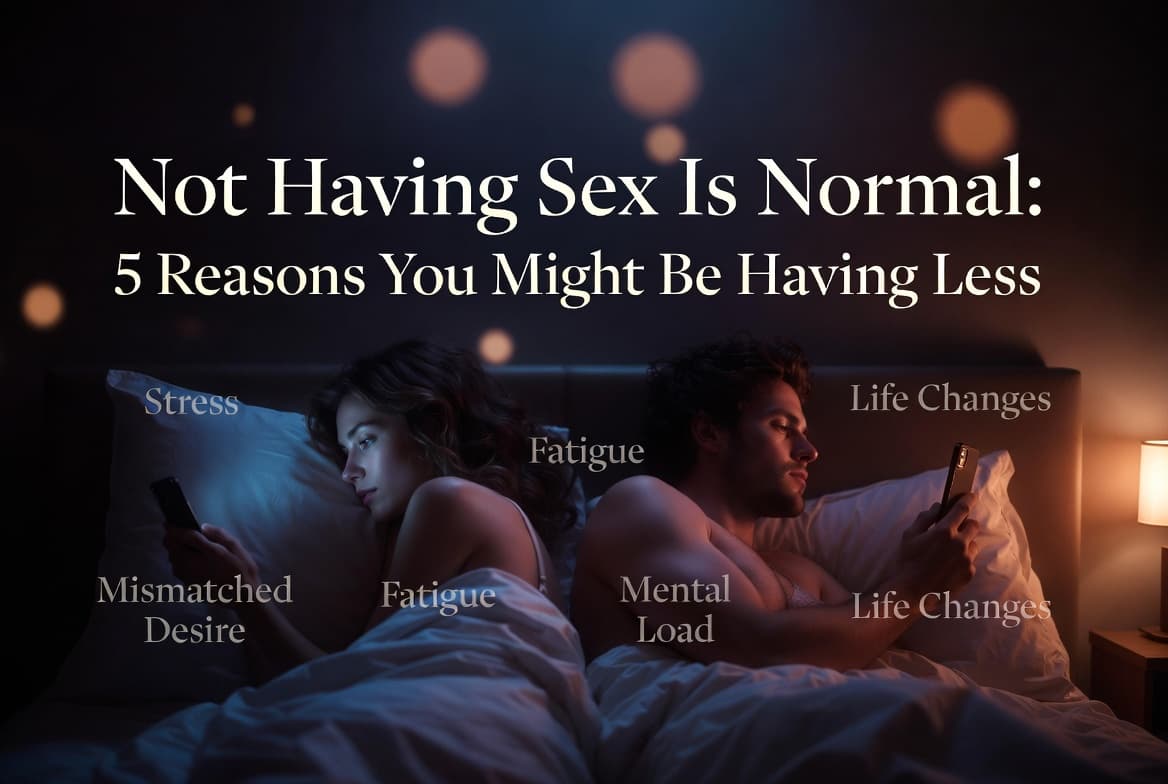
Not having sex is normal—and it doesn’t automatically mean something is wrong with you, your relationship, or your future. Desire can fluctuate with stress, life stage, health, identity, and your environment. If you’re having less sex (or none at all), you’re not alone.
Mainstream science media has been tracking the same question, too: why aren’t young people having sex as often? The discussion often focuses on ages 18–29, but many of the reasons apply far beyond that bracket.
This guide is here to do two things: (1) explain common, real-world reasons sex might be less frequent today, and (2) offer low-pressure ways to reduce anxiety and build closeness—without turning sex into a performance metric.

Not having sex is normal (and it’s not a personal failure)
For some people, less sex is simply a neutral preference. For others, it’s temporary—linked to burnout, moving, job stress, grief, mental health, meds, or relationship changes. And for some, it’s part of their identity (for example, people on the asexual spectrum).
It can also be influenced by culture and demographics. For example, reporting on Japan has highlighted how many young adults describe being sexually inexperienced or inactive, and how that becomes a societal conversation more than an individual one (see this Science Focus overview).
The key point: a “sex drought” isn’t automatically a crisis. Sometimes it’s a symptom of bigger pressures—and sometimes it’s just your normal.
Why people are having less sex: 5 common factors
- Cost of living and money stress
Sex usually thrives when people feel stable: time, privacy, energy, and a sense of safety. If you’re juggling unstable work, high rent, debt, roommates, or living with family, intimacy can feel like an “extra” you don’t have the bandwidth for.
This isn’t about being “too busy” in a motivational-poster way. Chronic financial stress can keep your brain in problem-solving mode—less likely to feel playful, present, and connected.
- Less drinking, fewer nights out
When a culture shifts toward drinking less and going out less, one side effect is fewer spontaneous flirtation moments and fewer opportunities to meet new people in person. That can be a positive change for health and safety—while also meaning fewer pathways to sex. - Internet life replaces in-person closeness (even when you’re social)
You can be very social online and still feel lonely in your body. Work calls, group chats, streaming, gaming, and endless scrolling can create a sense of connection—without the physical “co-regulation” that often builds desire: eye contact, touch, shared silence, being in the same space.
Online spaces are also easier to control. You can edit yourself, leave a conversation, avoid awkwardness. Real-world intimacy requires tolerating some vulnerability and imperfection.
- More options competing for your limited energy
Modern life offers dozens of ways to feel stimulated, soothed, or accomplished without dating: learning online, fitness, travel, creative projects, building a side hustle. That’s not sad—that’s variety. But it can shift sex from “default goal” to “optional activity.” - Loneliness and mental health load
Therapy language has helped many people understand themselves better. A less-talked-about side effect is that when you’re doing deep mental health work, you may temporarily have less capacity for closeness. Sex can feel like a high-stakes moment where your body and self-esteem are exposed.
Sometimes the issue isn’t libido—it’s fear: of being judged, of rejection, of feeling awkward, of not knowing what to do. And fear is a very effective desire killer.

How to tell if “no sex” is a problem (or just a phase)
A helpful test isn’t “How often should I be doing it?” It’s:
- Is this bothering me? (Or am I fine, and only worried about expectations?)
- Is this causing conflict or pain in my relationship?
- Did something change suddenly? (Stress, meds, health, sleep, conflict, a major life event.)
- Do I miss intimacy, or do I miss validation?
If you feel fine, it’s likely fine. If you’re distressed, the goal isn’t to force sex—it’s to find the underlying blocker (stress, fear, conflict, health, privacy, exhaustion) and address that.
Common mistakes that make low libido worse
- Turning sex into a scoreboard: pressure reduces desire.
- Skipping the closeness part: desire often follows safety, warmth, and playful connection.
- Assuming it’s only “hormones”: sometimes it’s sleep, stress, resentment, or anxiety.
- Trying to “fix” it in silence: secrecy often becomes distance.
A gentle, no-pressure checklist (solo or with a partner)
- Define what you actually want. More sex? More touch? Less anxiety? More privacy? More closeness?
- Lower the stakes. Replace “sex night” with “closeness time” (talk, cuddle, make out—no obligation).
- Protect your energy. Sleep, stress, and burnout are the boring-but-real foundation of libido.
- Create an easy opt-out line. “I want closeness, not sex tonight.”
- Talk about friction, not fantasies. What makes sex harder right now—time, privacy, body image, fear, conflict?
Why sex education still matters (even if you’re not having sex)
Sex education isn’t about pushing people to have more sex. It’s about making sex (and non-sex) less shame-based: consent, boundaries, communication, safety, and realistic expectations.
There’s evidence that gaps in sex education can echo into adulthood through relationship struggles; for example, this Psypost summary discusses links between sex-ed gaps and later difficulties.
Public conversations also often drift toward restrictions rather than accessible, science-based information. Example of recent news, see: Michigan adult content bill and VPN ban news.
FAQ
Is it normal to not have sex for a year (or longer)?
Yes. If you feel okay and it’s not harming your life or relationship, it can be completely normal.
Does a sexless relationship always mean the relationship is failing?
No. Some couples are happy with little or no sex. It becomes a problem when it causes ongoing distress, resentment, or disconnection.
What if I want sex, but anxiety shuts me down?
Start with low-stakes closeness and clear opt-outs. If anxiety is persistent, therapy can help—especially around shame, body image, or fear of rejection.
When should I talk to a doctor or therapist?
If the change is sudden, distressing, tied to pain, or connected to meds/health issues, it’s reasonable to consult a qualified professional.